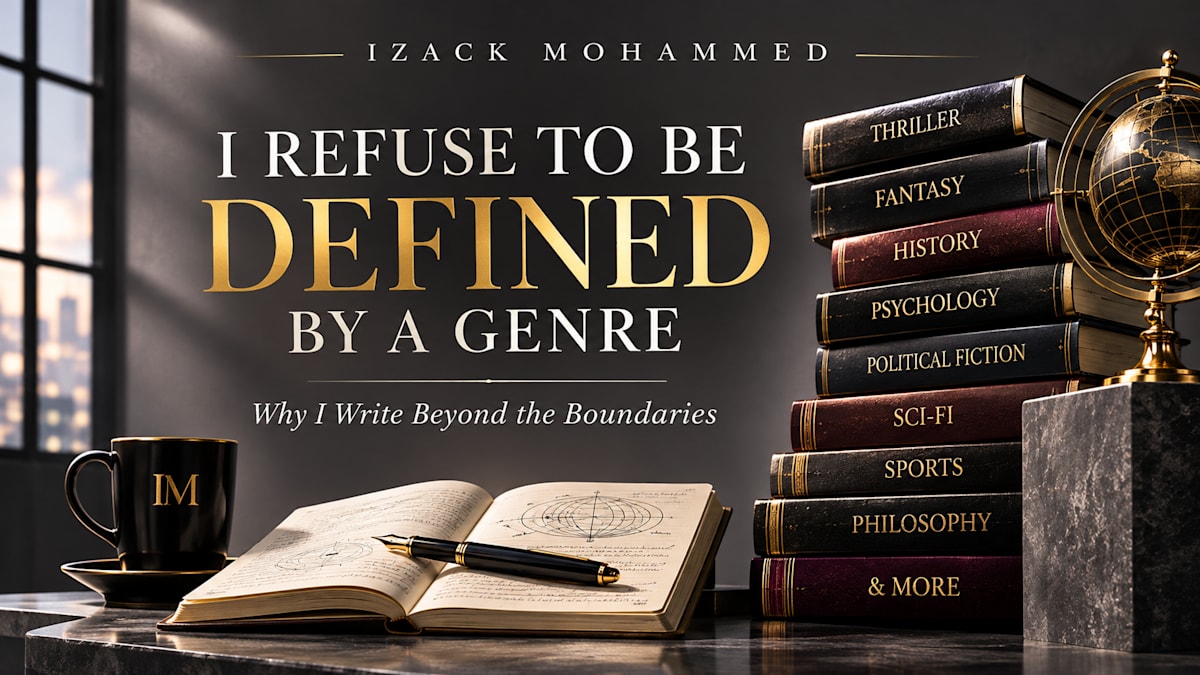
I Refuse to Be Defined by a Genre
An author should not have to live inside the boundaries of a single imagination.
By Izack Mohammed
There is a question that follows writers everywhere:
What kind of books do you write?
Fiction? Thriller? Fantasy? Romance? History? Philosophy?
The question seems harmless. Readers ask it because they want to understand what awaits them. Publishers ask it because categories make books easier to sell. The industry asks it because everything needs a shelf, a label and a market.
But I have never been entirely comfortable with the idea that an author’s imagination should have to fit inside one.
Why should a person who can explore the architecture of political power be discouraged from writing fantasy? Why should someone who writes psychological observations be expected to abandon historical storytelling? Why should an author have to choose between examining the human condition and creating an entirely new universe?
I don’t believe creativity should operate like a prison with beautifully designed walls.
THE PROBLEM WITH BEING PUT IN A BOX
The publishing industry understands categories. Categories help readers discover books, organise catalogues and communicate expectations.
There is nothing inherently wrong with genres.
The problem begins when a category becomes an identity imposed on the creator.
An author writes one successful thriller, and suddenly every subsequent manuscript is expected to resemble that thriller. An author becomes known for fantasy, and readers begin questioning why they would venture into psychology or political fiction.
Eventually, the writer risks becoming a prisoner of their own success.
I would rather develop an expanding literary universe than spend my life reproducing the same creative formula.
FIFTEEN BOOKS. FIFTEEN EXPLORATIONS.
My catalogue is an expression of that philosophy.
Blood and Blueprints: The Architecture of Power explores the relationship between power, systems and human ambition.
The Silent Contract enters the territory of mystery, suspicion and the hidden mechanisms behind seemingly ordinary agreements.
幻想 GENSŌ — PAY UP explores a different imaginative territory.
I, STAMFORD BRIDGE approaches storytelling through the emotional and historical identity of football.
Other titles explore psychology, society, personal boundaries, history and ideas that deserve to be questioned.
These books do not need to sound alike.
They do not need to share the same atmosphere, characters or narrative architecture.
They only need to come from a creator willing to explore.
That is the distinction I want to protect.
THE IMAGINATION HAS NO OBLIGATION TO REMAIN STILL
I believe an author’s greatest creative asset is not necessarily the ability to write beautifully.
It is the willingness to think differently.
To investigate an unfamiliar subject. To question an established belief. To construct a world that has never existed. To examine an uncomfortable truth. To move between intellectual territories without losing curiosity.
Writing is not simply the act of arranging words.
It is an encounter between imagination, observation, experience and possibility.
Sometimes that encounter produces a thriller.
Sometimes it produces a philosophical argument.
Sometimes it creates an entire civilisation that exists only between the pages of a book.
I want to experience all of it.
A DIFFERENT KIND OF AUTHORSHIP
My ambition is not to become the author of one particular genre.
I want to build a body of work that reflects the extraordinary diversity of human thought and imagination.
That ambition is also part of my 50 Books Before 30 challenge.
Fifty books will not mean fifty versions of the same story.
It will mean fifty opportunities to explore something different, develop something meaningful and discover what I am capable of creating.
There will be books that readers love, books that challenge them and books that take them somewhere unexpected.
I welcome that possibility.
I AM NOT BUILDING A BOX. I AM BUILDING A LIBRARY.
Perhaps one day readers will recognise my writing through a particular voice, a recurring philosophy or a distinctive way of examining the world.
But I don’t want that recognition to come at the expense of creative freedom.
I want someone to discover one of my books because they love political fiction, then discover another because they enjoy psychological exploration, and another because they want to disappear into a completely different universe.
I want the catalogue to surprise people.
Because the human imagination is not a single destination.
It is an expanding territory.
And I have no intention of limiting how far I explore it.
Fifteen books published. Thirty-five still ahead.
I am not interested in becoming predictable.
I am interested in becoming impossible to confine to one shelf.
— Izack Mohammed
50 Books Before 30.